
Best Schooling fish for Aquarium, Planted & Bare bottom
Hi guys, my name is Jatin Chhabra. I am a planted aquarium hobbyist since 2024, and this is my fourth post on a topic which I am seeing almost every day in my home and nearby aquarium shops, which is schooling fish.
So, this blog post is about the best schooling fish for aquariums, be it a planted aquarium or a bare-bottom aquarium, I will share only those fish which I have actually kept or actually seen in my friends’ or local aquarium shops, where I can say,
“Wow, now that’s one of the best schooling fish.”
In the below list, I will be sharing only those fish which are easily available, and at the bottom, I will also share a list of those fish which I thought would be good schooling fish but didn’t turn out to be that great. No disrespect to them; they are good fish you can try.
Rummy Nose Tetra
- Schooling score: 9/10
Rummy Nose Tetra are silver greyish colored schooling fish, which you can keep in a minimum of a 1.5 feet to 2 feet tank with a group of a minimum of 8 to 12.
If I have to rate Rummy Nose Tetra, in terms of schooling, I will give it 9 out of 10 because I have kept them in 1.5 feet to 3 feet tanks, and in all my tanks, I have never been disappointed by them.
They are always moving from right to left, and even if they are just not moving a lot or are just swimming near a corner of the tank, almost all of them will come together.
Another good thing about Rummy Nose is that their name is based on their nose color.
If you’re seeing that color as red, it means your water quality is good. There is no ammonia or, anything wrong with your tank water parameters which can harm a fish.
But if, on a normal day, you see that this fish is losing the redness of its color, do check the nitrate or ammonia level. So, they are also a good indicator fish for water quality.
The suggested aquarium water temperature for Rummynose Tetra is is 24 to 29 degrees Celsius.
Denison Barb
- Schooling score: 10/10
Second fish in my list, which for me is my favorite schooling fish to keep in a big tank, something like three to six feet, is Denison Barb.
Originating from the fast-moving rivers of Kerala, Denison barb is now being sold worldwide. Their body color of black and red makes them very attractive, and their body shape looks like a small torpedo.
Their movement is really fast, continuously from right to left, meaning they are very active and healthy.
The minimum tank size you should keep them in is around 3.5 feet to four feet. But if your tank has a bit of extra width, let’s say 18 inches, you can keep them in a three feet tank too.
But to see the best of them, keep them in a 4 feet plus tank, planted but not with very soft plants because they can eat them, and you have a fish which is continuously moving whenever you’re seeing the tank.
The best aquarium water temperature for Denison barb is between 22 to 26 degrees Celsius.
In summer, if your temperature is high, make sure it doesn’t go above 28 degrees Celsius. And if it’s going above 28, always add extra air stones.
Harlequin Rasboras
- Schooling score: 8.5/10
Third one, Harlequin Rasboras. Harlequin Rasboras are a bit of an underappreciated schooling fish, but after keeping them for two years, I can say that they are one of the very best schooling fish, along with a few tetras.
The Harlequin Rasboras originate from Southeast Asia, and they’re not very big in terms of size, just like 1.25 inches, but their length is also around a quarter of an inch, which makes them, you know, stand out in a planted tank.
To see the best of them, I suggest keeping a minimum of 8, and you can keep them in a tank as small as 1.5 feet.
And another good thing about them is that they’re perfect community fish.
I have kept my Harlequin Rasboras with even bettas, and I have never seen them attacking a betta or any fish with fins, which can’t be said for most of the tetras.
The best temperature for Harlequin Rasboras is 23 to 28 degrees Celsius.
Congo Tetra
- Schooling score: 8.5/10
Now, Congo Tetra is a very, or I have to say, one of the most beautiful fish I have seen in the planted aquarium hobby.
Congo Tetra can, when you buy it, be only around an inch or one and a half inches, but it can grow around 3 to 4 inches.
So, you need a big tank size of minimum 3.5 feet, or again, 3 feet if only the width is 18 inches plus.
The males especially develop these beautiful flowing fins and diamond like pattern on them, which makes them very beautiful and quite expensive compared to any other schooling fish.
I mean, I am getting a juvenile Congo Tetra for almost ₹ 300 to ₹ 400 per piece. So, do keep this point in mind.
Congo Tetras are easily available, but if you’re keeping them, you have to make sure not to try to make a community tank of 10 different types of fish.
Their combination needs to be properly set. Like, for example, one of my friends has 8 Congo Tetras with 8 Denison barbs in a 4 feet planted tank, and it’s working perfectly.
Rest, Congo Tetra is a hardy fish, and the best aquarium water temperature for them is 24 to 28 degrees Celsius.
Cardinal Tetra
- Schooling score: 8/10
Cardinal tetras are one of my favorite nano fish to keep in a planted aquarium, and they are some of the best schooling fish.
They look like a Ultra HD color fish in an aquarium if you add them to a planted one, because they just shine like hell.
Their blue & red mixture makes them stand out in almost every tank.
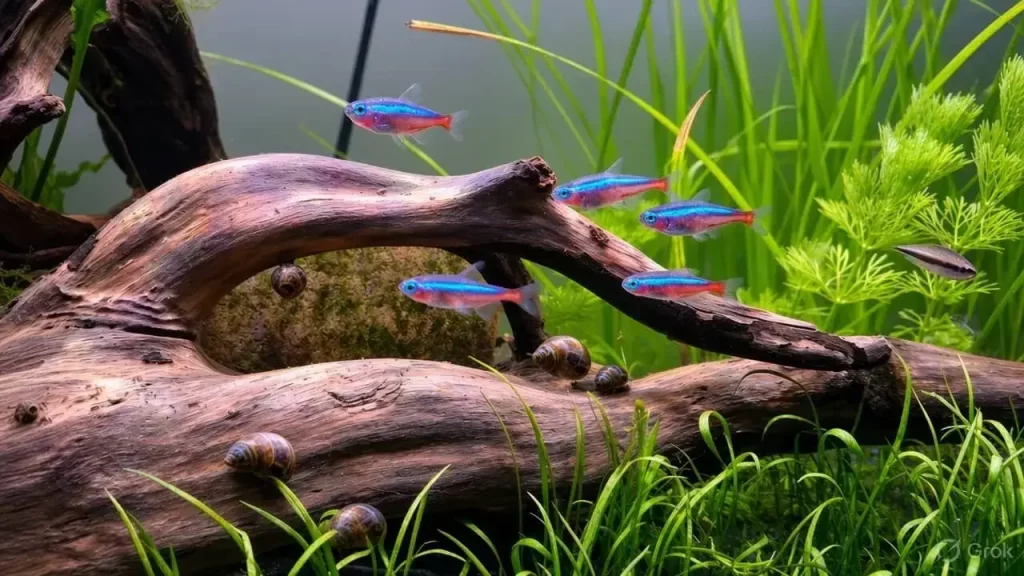
The only thing which you need to do is never bring them five, six, or even six fish in a tank. They are a bit more social; they need the numbers.
I first kept around 12 in a three feet planted tank, and they took the back side of the tank, and they were moving not very fast, slowly right to left, more like a graph going up and down, like it, and it was beautiful.
Even in my current 2.5 feet planted tank, I have around eight of them. In the starting, I had six. They were very shy, but after adding three more, they are now showing me more movement.
The best thing about cardinal tetras is they are temperature tolerant. You can keep them from a temperature of 24 to 29 degrees Celsius.
Pygmy Corydoras
- Schooling score: 8/10
In this list of best schooling fish, I would only like to add one Corydoras, which is the Pygmy Corydoras.
The Pygmy Corydoras are one of the smallest Corydoras fish, not more than an inch, but if you keep them in a group of six plus, you will see good schooling behavior in them.
You mostly see pygmy Corydoras at the bottom or mid-level of the tank, sometimes sitting on driftwood together, and you see a lot of reels about them, like they are having a discussion. They just sometimes sit like that.
Nevertheless, they are a beautiful fish to keep. I have ordered a 6.for my 2 feet tank because, for me, Corydoras are also an excellent fish to keep your substrate clean because they sniff sand a lot.
Best water temperature for Pygmy Corydoras is from 22 to 26 degree Celsius, and minimum tank size around 18 inch length.
Here is the same content arranged into three paragraphs, with your added point as the third paragraph and only grammatical changes:
Neon Tetra
- Schooling score: 7.5/10
Neon tetras are one of the most sold schooling fish in the world because of ease of availability, and yes, they school quite nicely.
But for me, they are not one of my favorite fish to keep.
I, as every other fish keeper does, went for neon tetras for my 1.5-feet planted tank, and yes, they were schooling together.
But for me, they were fighting mostly. Later, I shifted them to a three feet tank where they were doing much better. But sadly, I came to know about this point later that neon tetra does not like warm water.
They do well in a temperature of 22 to 26 degrees Celsius, and my planted tank in the starting years was around 28 to 32 degrees Celsius. So sadly, I lost them.
For hobbyist who are starting in this hobby, and if they can maintain a temperature of till 26 to 27, Neon Tetra is one of the cheapest nano schooling fish you can get in the market.
Temperature tolerance of neon tetra is from 22 to 26-27 degrees Celsius, and minimum tank size for them must be 1.5 feet to 2 feet in length. Go for the second. Go for 2 feet if possible.
Plus, one more thing about neon tetra, which I observed: they are daring.
Neon Tetra are not scared of bigger fish. I have seen my neon tetras bullying paradise gourami in a 1.5 feet tank, and sadly, even killing my betta sorority in just two days.
Green Neon Tetra
Schooling score: 8.5/10
Green neon tetras, a bit difficult to get but not impossible, are a close relative of neon tetra but different in color and size.
Unlike Neon Tetras, which like cold water, Green Neon Tetra can easily handle a temperature range of 23 to 28 degrees Celsius, making them much hardier than neon tetras.
For Green Neon Tetras, you can easily keep them in an 18-inch-length tank, and a group size, I would suggest is a minimum of 8-12 rather than keeping them in five or six.
Green Neon Tetras are excellent schooling fish, if put in good numbers, and will show you the perfect schooling behavior, especially in the middle part of the tank.
White Cloud Mountain Minnows
Schooling score: 9/10
White Cloud Mountain Minnows are some of the oldest aquarium-sold schooling fish, which I think have been in the hobby for more than 100 years.
A lot of websites and even local stores consider them as tetras, which they are not. But they are some of the best schooling fish. I can say that they are as good as Rummynose Tetras.
Finding White Cloud Mountain Minnows is quite easy, especially in Tier 1 cities or online. And if you are thinking of keeping them, do understand that they are cold-water fish.
They like a temperature of 18 to 24 degrees Celsius. They don’t grow much bigger than 4 to 5 centimeters, and they are very peaceful, actually quite active.
But if you keep them with other fish which are not in their temperature range, they will not be as active as you have hoped.
So, if you have a planted aquarium where you can maintain the temperature up to a maximum of 25 degrees Celsius, try them out.
Ember Tetra
Schooling score: 8.5/10
Ember Tetras are orange-colored, super nano-sized fish, which you can keep if you are a big fan of schooling fish. But with them, my experience is a bit different.
I have kept Ember Tetras in 1 feet, 2 feet, and 3 feet tanks, and their best schooling nature is always visible when there is a predator fish around.
So, for example, in my 1 feet planted tank tank, I kept them with a male Betta, and they were always together.
Later, I kept them in a 3 feet tank, and they were schooling very loosely. But when I added a pair of half grown Angels and a Pearl Gourami, I saw that they were schooling again.
So, this is the thing with Ember Tetras: they are beautiful schooling fish, easily available at low price, but if they don’t feel that there is any predator fish around, they will school loosely.
Nevertheless, they are beautiful fish to keep, and the best part is that their temperature tolerance is amazing. It is 24 to 29 degrees Celsius.
Pencil Tetra
Schooling score: 8/10
Pencil Tetra, which is mostly available as Red Pencil Tetra, is another good schooling fish, which requires a minimum of a 2 feet tank size.
I personally kept Pencil Tetra in a one and a half feet planted tank and later in a two feet tank, and I must say that I enjoyed their schooling behavior in the two feet tank.
In my smaller tank, they were always fighting with each other and, sadly, even harassed my female Paradise Gourami so much that she jumped.
But if kept in a big size tank, two feet plus tank, and in a number of eight to ten, Pencil Tetra is an amazing fish because they have this unique feature of almost standing in a position, like a dwarf cichlid, which makes them very unique to see.
Another good thing about Pencil Tetra is the temperature tolerance. You can keep them in a 22 to 28 degrees Celsius tank quite easily.
Silver Dollar Fish
Schooling score: 9/10
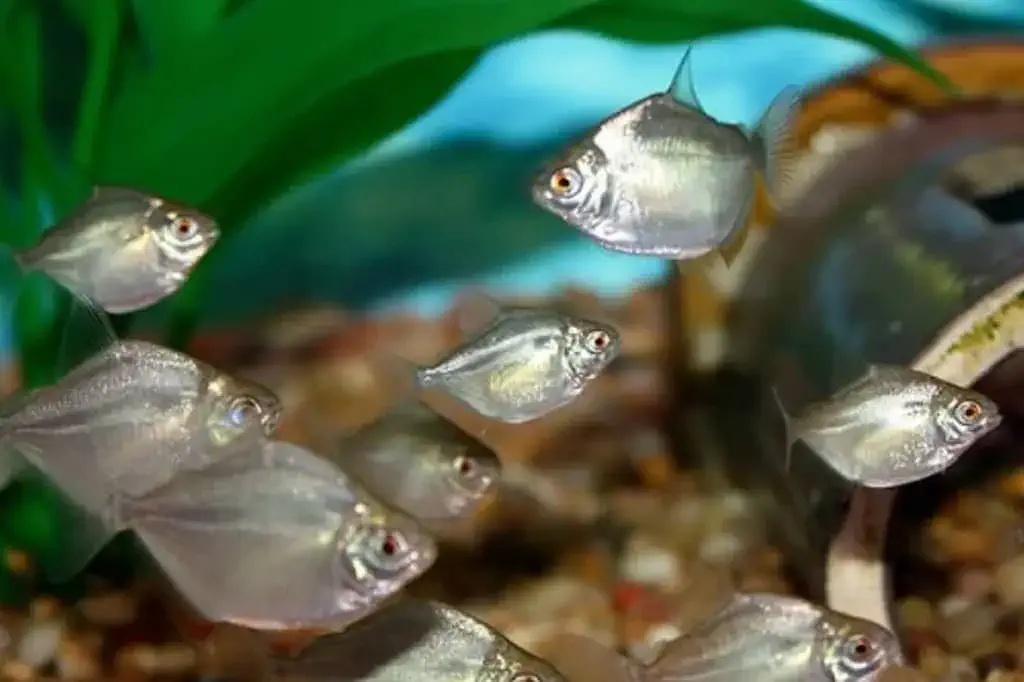
Silver Dollar Fish is something which you can’t keep in a planted aquarium, or you have to keep them in a very sophisticated planted aquarium where there are no soft plants.
Silver Dollars eat plants, as they are herbivorous fish but for me, they are one of the best schooling fish in a non-planted aquarium because of their looks, and second, because of their movement, which is very continuously right and left.
I have never seen them schooling loosely in a big tank, and yes, you must keep them in a big tank because they can grow as big as 6 inches in size.
I have mostly seen Silver Dollars in aquariums where there are a lot of African Cichlids. And as per my friends, they keep the Silver Dollars here so that the African Cichlids, which are sometimes harassing each other, sometimes follow these fish rather than their own breed..
Finally, the temperature tolerance of this fish is between 24 to 28 degrees Celsius, but the minimum tank size for them should be at least a 4 feet by 2 feet by 2 feet tank.
Glowlight Tetra
Schooling score: 8.5/10
Glowlight Tetra is a silver-colored nano fish, which goes somewhere around 3 to 4 centimeters or 1 to 1.25 inches. But when it comes to a schooling fish, these Glowlight Tetras are incredible.
If you’re keeping them in a planted tank, you will notice that on their body, an orangish-copper line, from their eyes to their back fins. And in a planted tank, when aquarium lights get on them, it looks like a small glowing LED light is in their body.
Keeping Glowlight Tetras is very easy. You just need to make sure they are in a group of 8 to 10. Tank size of minimum 18 inches in length or a 10 gallon planted tank. If the tank size is bigger, that’s good because now water temperatures are more stable.
Glowlight Tetras are excellent community fish. I’ve never seen them fighting or fin-nipping other tetras, rasboras, or even bigger fish with fins like Rams, Apistogrammas, small gouramis, etc.
Glowlight Tetra are best kept in a water temperature if 24 to 28 degree Celsius. So in summer, install a small fan on your tank.
Penguin Tetras
Schooling score: 6.5/10
Penguin Tetras, or commonly known as Hockey Stick Tetras, are another good schooling and shoaling fish.
Here I mention shoaling because you will not see them moving right to left in a planted tank, but more like revolving in the same space. Like, one fish is going right, one fish is going left, but still they are in the same place, moving more like a circular or oval type of schooling.
But still, Penguin Tetras are very attractive fish because of their size, which can go up to 2 to 2.5 inches. Their body shape is more silverish, with a black line that comes from their head to the backside and then goes to the back fin downward sides, presenting an image of a hockey stick or sometimes a penguin. That’s how they got this name.
If you are keeping them, keep them in a group of a minimum of 8 to 10 and a minimum tank size of 2 feet or around a 20-gallon tank because of their size.
Penguin Tetras are also pretty hardy fish, and they do well in a temperature range of 22 to 28 degrees Celsius. And they are not one of the best fish to keep in a community tank which has other fish with soft fins. They can be a little bit of fin nippers. So do remember that.
Bloodfin Tetra
Schooling score: 6/10
Bloodfin Tetra is also another fish of 2 inch plus size, which you can keep in a minimum 2 feet tank and see good shoaling and a bit of schooling behavior.
Bloodfin Tetras are quite easily available and mostly peaceful, but sometimes they can be fin nippy if their numbers are below six. So again, they are not the best community fish, but more like a species-only tank fish.
They can be kept with Penguin Tetras as I have kept eight of both in a 2 feet x 18 inches x 18 inches tank for quite some time before selling the tank.
And another reason to keep them is their hardiness. They can do pretty well in a tank with temperatures ranging from 18 to 28 degrees Celsius. That’s why, in some areas, you don’t need a heater for them.
Secondly, if you’re keeping them, always keep them in a group of eight to ten-plus, so that they are mostly chasing their own and not others.
And lastly, what makes them more attractive is their transparent, silver-greenish body, which looks amazing under planted-tank lights.
Scissortail Rasboras
Schooling score: 8.5/10
Scissortail Rasboras, for me, are a bit new because I just came to know about them a few months back. I am still in the process of buying them and keeping them in a tank of a minimum of 5 feet in size.
Scissortail Rasboras are actually a good substitute for Denison Barbs because Barbs don’t do well above 26 degrees, but Scissortail Rasboras can be kept in a temperature range of 22 to 28 degrees Celsius, with 28 being the last temperature range of comfort.
Scissortail Rasboras can also grow big, around 4 to 4.5 inches, or sometimes five inches, not more than that. And there silverish-green body and their back fins, which move like a scissor when this fish schools from right to left, make it very attractive.
Scissortail Rasboras are excellent schooling fish, and if you give them a tank of four feet plus, you will be rewarded with an excellent fish moving continuously in your tank. Especially if it’s a planted tank, they will look amazing.
In terms of a community fish scenario, Scissortail Rasboras are very peaceful. Actually, all Rasboras are very peaceful. I have kept Rasboras with Betta, Paradise Gourami, and I have never seen them nipping any other fish.
Plus, my plan is to keep one dozen of them with Angels in a five-feet planted tank. So we’ll share a video of that soon.
Conclusion
From the above list of 16 schooling fish, I have personally tried 10 of them, and the last one, Scissortail Rasbora, is in my bucket list, actually at the top of my bucket list, because I personally like Denison Barb a lot. But sadly, for them to thrive, providing a temperature below 26 degrees Celsius is a bit difficult for me.
Nevertheless, Scissortail Rasbora is one fish which is very similar in size and behavior, and I can keep them up to 28 degrees Celsius, which is a thriving temperature for them.
My only conclusion will be that please understand what type of temperature you can provide in your aquarium.
For this, you need to install a thermometer. You can get a manual one for around ₹ 150 to ₹ 200, or an electronic one for almost the same price or a bit higher.
Especially notice the temperature between the months of April to October, and then decide which fish you can keep. Because at the end of the day, you want, we all want, a fish to thrive in your aquarium, not just survive.
I hope this list might have helped you, and if yes, then please share this post with others.