Best Fish for Planted Aquarium in 2026
Hi guys, my name is Jatin Chhabra. I live in Jaipur, and I am a planted tank hobbyist.
From 2024 to 2026, I have made more than 20 planted aquariums, ranging from one-feet tanks to three-feet big-size tanks.
In these 20 plus tanks which I have made, I have kept two dozen plus different types of fish in my Planted Aquariums .
And because I only enjoy the planted aquarium hobby, I only keep fish that are suitable for planted tanks.
So, in this post on Best Fish for Planted Aquariums, I have shared around 30+ fish which I have kept in the past 2 years, and a few of them I am keeping right now.
I have also shared a video of all three tanks which are currently with me, because I live in a rented home right now.
Plus, I have shared more than 25 videos of the fish mentioned below in planted tanks, because, you know, we don’t just want to see pictures of these fish.
We want to see them in action.
So, I hope you like this post and if you want to ask me anything, share your message in the comments. I would love to reply.
Or you can subscribe to my YouTube channel and ask me anything there. My Channel
So, let’s get started with the best fish for planted aquariums.Best Fish for Nano Aquariums
For nano aquariums, I will suggest:
- 1-feet cube
- 1.5 feet × 1 feet × 1 feet
Why? Because a one-feet cube holds something around 5-6 gallon or 20–22 litres of water, and a 1.5-feet tank is also very popular because it is the starting 35-40 liter or 10-gallon tank.
So, if you are asking, “What are the best fish for a one-feet tank or a 1.5-feet tank?”, let’s start.
1. Guppies
The first one I will say is the easiest one to keep: guppies.
Guppies are one of the most easiest and difficult fish to keep.
They are easy because they are somehow hardy, easily available all over the world, and, my God, they come in so many colours. There is not a fixed number of guppy varieties.
If someone tells me they have seen 100 different types of guppies, believe me, I know guys who have bred more than 200 types of guppies.
For a one feet cube, you can easily keep something like:
- 2 males and 4–5 females
After one to one-and-a-half months, you may start seeing something like 20–30 guppy fry.
Now, a sad truth about fish is that parents eat their kids — almost all of them.
So, if your planted tank is not very bushy, a lot of these fry will be eaten by the parents. But some will definitely survive.
By a month, you may see that your original two males and four to five females have produced a few more fish which are now big enough that their parents can’t eat them.
The con with guppies
Guppies need a bit of extra minerals in the water.
For example, I personally use RO water for my planted tanks, which is good for tetras, which I will be sharing later. But for guppies, I have to add extra calcium, magnesium and other trace minerals.
For example, I use Seachem Equilibrium to raise the water minerals.
If you can manage that, guppies are one of the easiest fish: very colourful, very active and best for a beginner.
2. Endlers
Endlers are close relatives of guppies and are a bit difficult to find, but you can still find them.
Endlers are actually a bit more hardy than guppies.
Why?
Because guppies, especially the exotic ones like:
- 24 Karat Gold
- Emerald Green
- Japan Blue
are selectively bred.
A lot of times, the guppies you are buying are coming from the same siblings — meaning brother and sister are making more babies. That’s why a lot of guppies are now very weak.
But endlers are not the same case.
I have kept endlers, and most breeders don’t go for exotic endlers. There are a few, like Tiger Endlers and others, but they are quite hardy fish to keep.
So, the next best choice for a one-feet tank is endlers.
3. Betta — A Betta Only Tank
A betta fish is something like a fish puppy.
I have kept two bettas in the last two years — one male and another female (2 different tanks).
I personally like my female betta. because she feeds from my hand. If I put my hand in the water, she will come and sit on it.
Such activities make bettas one of the most sold fish.
A lot of people will say, “Oh, you can keep betta in just 10 litres.”
But no.
I think the minimum water requirement is somewhere around 15–18 litres.
For a one-feet cube, however, a single betta is a perfect option.
But if you want to keep multiple fish, then don’t keep a betta.
4. Ember Tetras
The fourth option is a fish which you can actually keep with a betta: ember tetras.
Ember tetras are again one of the most hardy tetras. Though some tetras are very hardy, not all of them are.
You can easily keep ember tetras in a one-feet cube, surprisingly even with a betta.
They are orange-coloured fish.
It is almost impossible to know which one is male or female because the coloration comes on both of them. This is unlike guppies or endlers, where females are a bit less colourful.
For a one feet cube, you can easily keep 7–8 ember tetras, even with a betta.
And if you have something like a light background, they will just pop out, especially that orange colour.
5. Threadfin Rainbowfish
The next fish which I think you can keep in a one-feet cube is threadfin rainbowfish.
Threadfin rainbowfish are one of many rainbowfish, especially the nano-sized ones.
They come in dark and light colours.
Male and female can be easily separated because males flash their fins at 90 degrees to impress the females.
I have personally kept:
- 6 threadfins
- 5 endlers
- 5–6 guppy
in a one-feet cube.
Because there are so many small fish, I never had too much worry about the water quality.
So yes, you can also keep threadfin rainbowfish in a one-feet tank.
And that’s it.
I think these fish are enough for a one-feet tank.
If you want to know that how I make planted aquariums, then checkout my 1st guide on Planted Aquarium setup cost in India in 2026.
Best Fish for a 1.5-Feet Planted Aquarium
Now let’s come back to nano planted aquarium fish which you can keep in a 1.5-feet tank.
When you go for a one-and-a-half-feet tank, you are increasing the water volume, which is good.
Secondly, now you can keep fish that are 2–3 inches in size.
Apart from all the fish which I have mentioned above, you can also keep the following fish.
6. Platies
One of the cheapest and hardiest fish to keep in a Planted Aquarium is the platy.
Like guppies, platies also come in various colours.
Some common varieties are:
- Sunset Platy
- Calico Platy
- Swordtail Platy
- Red Coral Platy
- Balloon Platy
Balloon platies are not one of my favourites, as they get fin rot easily
The best thing about platies is that they can handle a wide range of temperatures.
I mean, you can keep them as low as 22–24°C to 28–30°C.
But the best temperature would be around 24–28°C.
Same like guppies, if you want to keep Platies, keep one male with two to three females, and you will be blessed with lots of babies.
Sadly, platy fish are also being sold as feeder fish. That means people buy them, keep them and feed them to their big-size fish like arowanas or Oscars.
But I personally kept very colourful platies in my one-and-a-half-feet tank, and their constant movement, very fast and constantly coming when you add food, becomes very lovely to watch.
And again, they are very easy to keep.
7. Neon Tetras
The second species you can keep in a 1.5-feet tank is neon tetras.
Neon tetras are again not my favourite, but I am mentioning them because I think they have become one of the most sold fish in the world.
They are mostly blue and red, and the HD colour style attracts a lot of people.
They are commercially bred a lot, which is why they have also become very vulnerable.
But still, if you keep the water quality clean and manage a good temperature, you can keep something like 8–10 neon tetras.
Now people will say, “Keep six.”
But believe me, I have kept neon tetras in a tank, and I think the biggest mistake I made was just buying six.
In these 6, there were two females and four males, and there was a lot of chasing.
If I had gone with something like 8–10, I would have got a more natural ratio with a few more females, and my tank would have been more enjoyable to me.
Later, I shifted my neon tetras to my three-feet tank.
But again, if you are making a one-and-a-half-feet tank and don’t like the above options, neon tetras are your fish.
8. Rummy Nose Tetras
Another fish which I have suggested for this tank is rummy nose tetra.
Now I know a lot of people will say, “You need to keep them in a big tank.”
And yes, it’s true.
Rummy nose tetras are very active fish.
When I put them in a one-and-a-half-feet tank, as I did, they were constantly moving from right to left, right to left.
The only thing you need to do is give them some open space.
At least in the front, don’t have big plants, driftwood or rocks everywhere.
Give them some open space and they will love it.
Keep them at least 6–8.
Here, you can keep six.
I have not seen rummy nose chasing each other a lot, like neon tetras.
The problem with rummy nose
The only thing about rummy nose is that whenever I am getting them, they are very weak.
Maybe it is because of transportation, or maybe because when I am buying them from a local shop, they are not always the best quality.
So what I did was always drip=acclimate the fish before adding them to the tank.
Or even better, quarantine them for two to three weeks if you can.
9. Cherry Barbs
The next fish which you can keep in a one-and-a-half-feet tank is cherry barbs.
Cherry barbs, for me, are one of the hardiest fish for a Planted aquarium.
They have been in the planted aquarium and normal aquarium hobby for a very long time.
They are easily available, and you can easily identify the male and female because of their colours.
They are also very interesting fish to keep.
Just keep 6–8.
A lot of people keep them in front of a filter, but I am personally not with that.
I suggest everyone should always have a filter in the tank.
Cherry barbs are not very schooling fish, but still you will see them moving a lot.
And barbs are actually quite hardy in comparison to tetras and guppies.
Don’t expect too many spawns, but again, a light-background tank with cherry-red fish is lovely to watch.
10. Drape Fin Barb
Drape fin barb is an Indian species from the barb family, hard to find but not impossible.
They have these crown-type fins on their head, which makes them very beautiful.
They are quite small in size.
But if, based on their size, you are thinking of keeping them in a one-feet aquarium, no.
Barbs are active.
They need space.
So you can easily keep 8–10 in a one-and-a-half-feet or 10-gallon tank.
And how the male and female interact with each other looks very beautiful.
11. German Ram, a Dwarf Cichlid
Now I have already shared a lot of fish which you should keep in groups of at least six to ten.
But there are other fish which you can keep even as a single specimen or as a pair, but not more than that.
One of them is the German ram.
German ram is actually not from Germany.
It is a South American fish.
It is a very beautiful and vibrant fish. You can find almost every colour of the rainbow in this fish.
Both males and females look very bright.
And surprisingly, if you are providing the right temperature, they like a bit of hot water — around 26–28°C, even 29°C.
For breeding, people keep them around 30°C, and they can give a lot of offspring.
Unlike tetras, they are livebearers.
The female doesn’t lay eggs. She keeps the babies until they are free-swimming and then lays them out.
I have also seen myself that the female keeps the fish in her mouth to save them from other fish.
Now do understand that the parents may get aggressive when they have babies, but not so much that they can kill the other fish.
12. Apistogramma, anther popular & expensive Dwarf Cichlid
Another solo or couple fish which you can keep in a planted tank is Apistogramma.
Apistogrammas also belong to the South American cichlid family, like rams.
But don’t even think of keeping rams and Apistogramma in the same tank, because one of them will die, maybe both.
With Apistogramma, it is best to keep:
- One male
- Or one male + one female
in a planted tank.
These fish are also hot-water-loving fish, liking temperatures between 26–30°C.
Colour-wise, some of them are extremely colourful, like Apistogramma agassizii Double Red.
I have a Apistogramma cacatuoides Orange Flash, which is currently in my 2.5-feet tank.
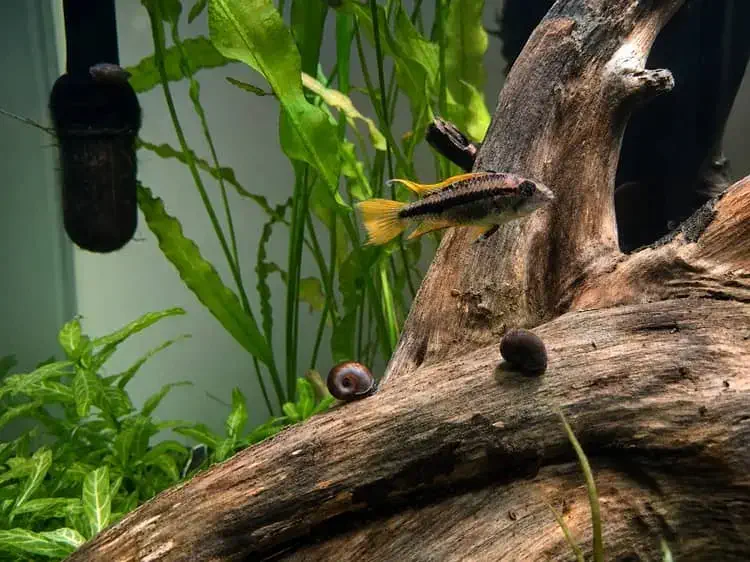
The movement of these fish, their behaviour and their looks are so mesmerizing that people are selling these fish at a very high cost.
For example, I bought mine for almost ₹900 from Ativ at Jaipur Planted Aquarium.
Water requirements
The only thing to keep in mind is that they need a bit of soft water.
If you are providing borewell water, it is not good for them.
RO water, or RO water mixed with tap water, can work depending on the resulting water parameters.
If you want them to thrive, soft water around 100–300 TDS can work.
13. Peacock Gudgeon
The next fish which you can keep in a 1.5-feet planted tank is the peacock gudgeon.
A lot of people call them peacock goby, but they are not goby fish.
They are peacock gudgeons.
You can keep:
- One male + one female
- Better: one male + two females
But do remember, they hide a lot.
So you need to make your planted tank a bit bushy at the back so they have plenty of hiding space.
When the male and female lay eggs, they guard their cave.
I personally suggest giving them a half coconut shell with a hole.
You can even grow moss on it, and they will make their home inside it.
Same with Apistogrammas, their colours, movement, egg guarding and fins are very attractive.
And believe me, this tank size is minimum for them.
If I had to keep them again, I would keep them in a minimum 2-feet tank.
But still, they can be kept in a 1.5-feet tank.
14. Odesa and Melon Barbs
Another fish which you can keep in a one-and-a-half-feet tank is Odesa and Melon Barbs.
The most common barb being sold everywhere is the tiger barb, but they are not the best for planted tanks.
Why?
Because they can definitely uproot a lot of plants.
But that’s not the case with Odessa and Melanobarbs.
A lot of people keep them in planted tanks.
But then again, if you are keeping barbs, don’t expect too much of a community tank.
Why?
Because they are not as aggressive as tiger barbs, but still, they are barbs. Same size, same family.
They will be chasing each other a lot.
Plus, if you are making a planted tank for them, I would suggest not adding soft plants like Monte Carlo, because they can be eaten by them.
15. Honey Gourami
Honey gouramis are some of the most peaceful gouramis fish which you can keep in a Planted Tank, or even a Planted Tank Community.
The most popular one is the yellow honey gourami, which I have in my 2.5-feet tank, but they can be difficult to get.
The common ones are:
- Red honey gourami
- Dwarf gourami
- Neon gourami
They don’t normally go above around 2–2.5 inches.
You can easily keep:
- One male + one female
But not two males.
Even though they are peaceful, if you keep two males, they will chase each other a lot.
And surprisingly, the honey gourami, which people call the saint of a planted tank, can kill another male by continuously harassing it.
But yes, this is a popular community fish.
You can keep honey gouramis with:
- Tetras
- Guppies
- Rasboras
and it will look fine.
Absolutely — continuing in the same language and narration style, while keeping your personal experience and structure intact. I’ve also kept this as the continuation of the 1.5-feet section.
16. Kuhli Loach or Zodiac Loach (2 different fish)
Next fish: Kuhli Loach, or go for Zodiac Loach.
Now, Kuhli Loach is the most popular loach available in the market. Zodiac Loach is more of an Indian loach.
Kuhli Loaches are very shy. There is a good chance you will not see them during the day, because sometimes you even have to feed them at night.
But Zodiac Loaches, you can see them almost all the time.
Loaches are very thin fish, more like a big worm or a small snake, and they again like company.
I mean, you can’t keep one male and two females, or one male and one female. You need to keep at least four to 6.
They will do some chasing, but the good thing about them is that if your tank is very dense and if a lot of food gets left at the bottom, they will eat it.
And the second thing — if you keep them with guppies, now this is something interesting I can share with you.
If you have a problem where your guppies or even platies are giving you a lot of babies, and you are concerned that if too many of them grow big, the water quality will become bad and may even kill the fish because of poor water quality, you have to understand the natural behaviour or nature of fish.
Fish eat fish.
So loaches — Zodiac Loaches and Kuhli Loaches — are some of the best fish to keep in a tank with a lot of guppy fry and platy fry, because they will control the population, a.k.a. they will eat the fry.
I personally have Zodiac Loaches. I have three.
Sadly, I wanted more, but only three were available for my two-feet tank.
And believe me, when I wanted to rescue the tank, it was almost impossible to take them out because they are so fast.
17. Purple Emperor Tetra
Now, I am mentioning this for a one-and-a-half-feet tank, though I am keeping six in my two-and-a-half-feet tank.
But this is based on my experience.
This fish is a bit unique in colour because of the light purple colour on the top line.
They don’t grow more than around one inch, or sometimes around one-and-a-half inches.
They don’t school tightly like rummy nose and neon tetras.
And I think because of their size and their comparatively less movement, you can easily keep them in a one-and-a-half-feet tank.
Now, I am sharing this for those people who have some experience in keeping tanks.
Because when you go to a shop and see neon tetras and other bright tetras, you might not buy them immediately.
Instead, bring these fish home, give them some time and provide them with good-quality food.
The colours will come.
And then you have a unique fish to keep with you.
18. Harlequin Rasboras
Harlequin Rasboras are now one of my favourite fish to keep.
I have eight of them and they have been with me for more than one-and-a-half years. They are in my 2 feet tank.
They grow to a maximum of around one-and-a-half inches, but their length is like ¾ inch.
They are not as fast as tetras.
They are not as colourful as tetras.
But my God, if you keep them in a group of 8–10, or sometimes 15, they will school in such a good way.
I have actually kept eight Harlequin Rasboras and eight Espei Rasboras.
They are very similar, but Espei Rasboras are a bit brighter than Harlequins.
So I have a total of 16 of them.
They swim a lot together, and what they do is they just like to come in front of the water flow.
I don’t know, maybe they like a bit of fast-flowing water.
But again, you might not buy them because of their dull colours.
But they are very rewarding fish to keep.
19. Sparkling Gouramis
Now I am mentioning this fish as the last fish for a nano tank.
Don’t keep it in a one-feet tank. Just don’t.
Either just a male or a female — no.
The best is to keep them in a group of five, and your tank should be heavily densely planted.
I kept five of them, and be aware that if you are keeping guppies, endlers or rainbows in the tank, they can kill them.
As blunt as this sounds, this actually happened to me.
I had a tank which I later sold. It was 1.5 feet in length, 1 foot in width and 15 inches high.
Actually, this is something I should have shared before: if you are making a 1.5-feet tank, and if you can raise the height to 15 inches, that tank will look amazing.
Now, coming back to the topic.
I kept five sparkling gouramis. Then I had my six rainbows, five endlers, one exotic guppy, and a big-size platy — the only one I have till date.
After two weeks, I noticed that there were only three endlers, three rainbows, and my exotic guppy had a torn fin.
I did some research and understood that it was the sparkling gouramis.
So I immediately took my endlers and guppy out of the tank.
Sadly, the guppies didn’t survive, but I came to know that these blue-eyed, sparkling gouramis are actually monsters.
But if you like nano monsters, this is your fish.
That’s It for the 1.5-Feet Tank
Yeah, I think that’s it for the one-and-a-half-feet tank.
Now, guys, apart from these 18 fish I have suggested above, there are many more fish you can keep in 1 and 1.5 feet planted aquarium.
But try them when you have some experience.
For me, from 2024 to 2026, I have built 20 planted tanks and sold 17 of them.
I still have three tanks, ranging from one feet to two-and-a-half-feet.
And I do have plans to make two five-feet tanks.
I have tried all of these fish, apart from Peacock Gudgeon, which is still on my bucket list. And I will be soon adding them to my two-feet tank.
Plus I have also made a guide on all the Aquarium Plants I have used since 2024 from Low tech to high tech, then checkout it at Best Plants for Aquarium in 2026
Best Fish for 2 to 3 feet tanks
So fish for 2 ft, 2½ ft, and 3 ft tanks. The best tank sizes you can get or make for planted aquariums from 2 to 3 feet are (Length x width x height(:
- 2 ft x 1 ft x 1 ft (6 mm glass)
- 2 ft x 1 ft x 18 in (6 mm glass)
- 2 ft x 1½ ft x 1½ ft (6 mm glass)
- 2½ ft x 1 ft width x 16 in height (6 mm glass)
- 3 ft x 1 ft x 15 in (6 mm glass)
- 3 ft x 1½ ft x 1½ ft (8 mm glass)
Now, let’s get back to fish.
20. Zebra Danios
Here’s a polished version keeping your storytelling style and almost all of your original words, while making the flow smoother and correcting a few factual points.
While writing this post, I finally bought Zebra Danios on 2nd September.
Before that, I had been seeing them in aquarium shops for more than two years, but I never thought of buying them.
The reason? In the first year of my hobby, I never had a tank bigger than one and a half feet. And even when I got a bigger tank, I was more attracted towards tetras because of their colours.
You know, the thing about neon tetras and cardinal tetras—you like them because they are beautiful. But when you go deeper into the hobby, you eventually need something new.
And that’s exactly what struck me in my 2.5-feet tank. I noticed that my tetras were not schooling very tightly. They were becoming a little lazy, apart from the rummy-nose tetras.
So I thought, which fish should I add here?
The whole web was telling me: go for Zebra Danios if you want to see movement in the tank.
And that’s absolutely true!
I originally thought of buying eight. Some people suggested ten, but sadly, only five were available at the shop.
So I bought five.
After almost two hours of drip acclimation, when I finally added them to the tank—my God! The whole tank was like, “Who the hell has come home?
Even the slow-moving tetras are now moving fast.
Just see what these Danios are doing!
Quick points about Zebra Danios:
The original Zebra Danio, Danio rerio, is a species native to South Asia, including India. The natural form has the beautiful blue-purple and silvery striped pattern.
You will also find different colour varieties in aquarium shops, including orange, golden and fluorescent varieties. Some are selectively bred, while GloFish varieties are genetically modified. You can keep them if you like.
I just bought the basic natural-looking variety.
And surprisingly, one thing I recently learned about this fish is that Zebra Danios have an amazing ability to regenerate certain tissues and organs after injury. Scientists actually study them to understand how regeneration works.
Very interesting fish!
If you have at least a 2-feet tank, believe me, you would love to see them. And in a three-feet or four-feet tank, they can be even more fun because of all that movement.
Maybe in the future, I might keep a dozen or even two dozen in a five-feet tank just to experience that movement.
They are amazing fish! 🐟
I changed the “ramirezi tetras” part to rummy-nose tetras, assuming that was what you meant. Also, I softened the regeneration claim because Danios are famous for regeneration, but the original wording about a fish growing back a body “portion” could be misleading.
20. Angelfish
The biggest fish which you can keep—apart from one more which will be at the end—that you can keep in a planted tank and will look simply amazing are angelfish.
I have kept mostly red cap and koi angels with me, and I must say angels deserve the tag which I am giving to them after bettas: water puppies.
Angels love and know their owners.
They will come to you and they will even take food from your hand if you just put your fingers in.
One more thing: if they are breeding, they can even bite you, but don’t worry—it’s completely safe.
If you want to keep angels, there is one good strategy:
Buy five juveniles and keep them in a minimum 2 ft or 2½ ft tank size mentioned above.
As they grow, they will bond into pairs, so you will know which ones are male and female.
If, for example, you get two pairs, then you have to move one pair to another tank.
The last remaining single fish will need to be rehomed. Why? Because if you don’t, it will be harassed.
If the tank is big—let’s say a 3 ft tank—they can still survive, but if it’s a 2 ft tank, that lone one will be killed. It’s as simple as this.
Angelfish come in many varieties. Easily available ones are marble, koi, and red cap.
You can get them for around Rs 250 for one or a pair. And if you want to keep a royal fish, just search for Altum Angels.
21. Pearl Gourami
Now, I’ve already mentioned honey gourami and neon gourami above, but they are around 2 to 2.5 inches.
If you want to keep a big-sized gourami, there are a lot available, but the best gourami fish for a planted aquarium is the Pearl Gourami.
This fish can go up to 5 inches.
Even their height is good, somewhere around 2 inches to 2.5 inches.
They have this pearl-type pattern on their bodies.
It’s not very tough to know which is a male and which is a female, as female lower body is more of C to U shape.
Only thing to remember: try to go with like one male to two females or three females.
Same thing with pearl gouramis—they know their owners.
Pearl gouramis interact with their owners and can be trained to feed from your hands, but it may take some time.
Care points for Pearl Gourami
- Temperature: They like 24°C to 28°C, with a maximum of 30°C–31°C.
- Water: They like soft to moderate water, somewhere around 150 to 350 TDS.
22. Cardinal Tetras
Cardinals are one of my favorite tetra fish to keep.
They are as attractive as or even more attractive than Neon Tetras, which people often feel are the same, but they are not.
What I love about them is their temperature tolerance.
Neon Tetras are cold water fish that like temperatures from 22 to a maximum of 26 degrees, but I live in Jaipur. In summer, outside temperatures hit 50 degrees and room temperatures can go up to 32 to 35, though I maintain it easily at 28 degrees Celsius with a fan.
Cardinals can easily handle temperatures from 26 to 30 degrees.
I keep them in a group of six or more. Yes, you can keep six easily, and the minimum tank size is 2 feet. I have eight of them in my 2.5 feet tank.
One thing you need to make sure of is properly acclimating them. I sadly lost two fish in the first week because of ich.
The main reason was that they were kept in a very hot store where I bought them, and my room is mostly AC to maintain a temperature of 26 degrees.
On day three, I noticed a fish had ich, and though I treated them, I lost two. This made me learn more about how to keep my fish alive. If I talk about the top five schooling fish, Cardinal Tetras are in the top three for me.
23. Neon Rainbows
Neon Rainbows is a silver color, highly attractive schooling fish, around 2 to 2.5 inch. Must be kept in a group of 8 to 10, not 6, because if kept low, they have this tendency to nip others, like angelfish.
Their availability is really good, so you can buy them a bit cheap. Keep them in a tank of minimum 2.5 to 3 feet.
You can keep them in a 2 feet tank, but remember that they’re very active and need a bigger tank. In a 2 feet tank, if you keep them with other fish, they may nip them. In a 2.5 to 3 feet tank, you keep them with almost everything mentioned in this list, and no one will see that type of behavior.
The best thing about them is that they’re still very, very hardy fish like most of the rainbows.
24. Bloodfin Tetras
This is a very tricky fish to keep. I first kept one in a 1.5 feet tank, and that was a mistake because they are aggressive towards each other most of the time.
I had two 1.5 feet tanks kept on a table, and I literally saw that one fish, which was being chased by the others, just jumped into the second tank.
If you keep Bloodfin Tetras in a 2 feet tank with good hiding space, they will be schooling mostly in a circle type position, directing anger towards themselves, so that’s why keep a minimum of 8 to 12.
Appearance wise, they’re very unique with a transparent body. I don’t know why they call it Bloodfin, as it is mostly grayish and transparent. Don’t keep them with other high fin fish like angels.
25. Hockey Stick Tetra
This is a very interesting fish to keep. Their appearance is around 2.5 inch easily.
Not very aggressive like Bloodfin Tetras.
Some people call them penguin tetras because of their shape. Easily breedable, and quite hardy.
They can stay with you for 2 to 3 years, maybe more if the tank parameters are met. Again, to be kept in a group of 6 to 8. They need a temperature of 24 to 30 and a minimum 2 feet planted tank size.
26. Black Neon Tetra
Black Neon Tetras are related to Neon Tetras, but their size is just a bit bigger, like almost 1.5 inch plus.
Their body shape is not as attractive as Neons, but it has a very distinct feature with blackish light silverish gray on top.
I have eight of them in my 2.5 ft tank. They are very peaceful with other tetras like Cardinals, Blue Emperors, and Rummy Nose Tetras.
And most of the time they are not moving as fast as Rummy Noses. They are mostly in a small group, but not moving too much.
27. Algae eater fish for your planted aquarium
Planted tanks, especially in the early phase, will go through a stage where your tank gets algae.
Either you maintain it by lowering your lights and making regular water changes, or you keep fish that can eat algae.
Otocinclus catfish
Otocinclus catfish are rated as the best fish to reduce algae in your tank. You should keep a minimum of 4 to 5 in a 2 ft to 3 ft tank.
They will eat algae from your glass, from your plants, and from your hardscape.
They are excellent, but they have one con.
If your tank is low or almost very low on algae, you need to substitute their diet with other food, especially blanched vegetables.
A lot of people also try to train them on algae wafers, but sadly a lot of them don’t take to them and die because of hunger. So, be ready to offer them blanched cucumber.
Siamese Algae Eater:
Siamese Algae Eaters are a bit difficult to get, but not impossible. They are one of the best algae eater fish you can get in the market. Be ready to pay something like 200 plus for one.
I have kept many in my bigger tanks ranging from 2 to 3 feet. You can keep a single specimen, but if you have a 3 feet tank, you can keep 2 to 3. They will eat almost every type of algae, even black beard algae. Plus, the good thing is they even eat normal fish food and even dead fish.
The only con, which is not a con for me but for people who think they are pure algae eaters, is that if your tank has no algae, you need to give them other food like algae wafers (which a lot of them don’t eat) or blanched vegetables like cucumber, and as they grow with time, they start expecting normal food.
Bristlenose Pleco:
A Bristlenose Pleco is an excellent algae eater for a planted aquarium.
They grow up to 5 inches maximum, making them suitable for tanks from 2 feet and above.
Always ensure you have driftwood in the tank for them to graze on, as it is essential for their digestive system.
Apart from these three expert algae eaters, you can keep shrimps, and surprisingly, gouramis like honey gouramis, pearl gouramis, and moonlight gouramis. Even though they are not pure algae eaters, they definitely feed on algae a lot.
It is also said that a lot of livebearer fish like platies, guppies, and mollies eat algae—especially mollies—but they are not as good as the top three mentioned above.
The only exceptions here are shrimps, and one of the best shrimps to keep for algae is Amano shrimp. They are a bit difficult to keep, but not impossible. They are excellent algae eaters, and their size can even reach around 1.5 to 2 inches.
28. All the other fish which I have kept for more than 20 tanks in the last two years
So, 90% of the fish and shrimps I have shared above, I have personally kept.
Most of them were bought from local stores and quite a few from online websites. You need to be aware of online buying because in India there are a lot of frauds when ordering fish online, plus it is quite risky. That is why I don’t like ordering them online.
Apart from these, I have also kept fish like:
Marble Gouramis:
Quite similar to the Pearl Gourami, but they say they can get a bit more territorial than them. Still, it is a very nice fish for a planted aquarium.
Golden Gourami:
Now, this is a very beautiful fish, but sadly when they grow old, they become territorial. So, if you are keeping them, keep them in a 3 ft tank with other community fish, but never with another Gourami.
Crooking Gourami:
Now, I bought this fish after reading a lot of reviews online saying, “Oh, this is a very peaceful Gourami.” But I was wrong. It is a damn hunter!
I recently bought some exotic guppies and they kept dying one by one. I was suspecting the tetras, but one day I noticed my Crooking Gourami was eating up my 24-karat exotic guppy.
I immediately took the Gourami out, posted him on my WhatsApp groups to see if someone could rehome him, and got rid of him the same day. This is an interesting fish to keep, but take some precautions.
And finally, a fish which has become my favourite. And I am adding it because it is very tricky to keep. Sometimes it is very peaceful, a good community fish. Sometimes it is just not good for people who want a community aquarium fish in their planted tank. It’s the
Albino Paradise Gourami or Paradise Gourami.
I have kept three in 2 years. The first one I got sadly died because the water quality was not maintained in my office.
So then I got one more, which was attacked by another fish named Yellow Panchax and he jumped out of tank, and that was the reason I will never buy a Panchax again.
And now I have got an old red and silver mixed Paradise Gourami.
I am keeping him with Harlequin Rasboras in a very jungle-style 2 ft planted aquarium.
I am just not keeping tetras over there, not because he can kill tetras, but tetras can fin nip him.
Since mine was already being beaten up by another Paradise Gourami in a single tank, he’s not very brave to fin nip others.
But when I kept him in clean water, he is simply amazing. Check out his video above, its from my 2 feet planted aquarium with Paradise Gourami.